

A plaid sweater can be the hardest-working piece in your winter closet, or the one that sits unworn because every outfit with it feels slightly off. The difference is rarely the sweater itself. It is the scale of the check, the colors around it, and the way it is layered and tucked.
Learning how to style a plaid sweater comes down to a handful of decisions you make before you leave the house: one plaid piece only, solid partners, a fit that shows your shape, and shoes in good condition. Get those right and the same sweater works for the office, a holiday party, and a cold Saturday of errands.
The rule in section 4 — the one about layering order — is the change that fixes most plaid outfits in a single move. Once you see it, you will spot the problem in your own closet in seconds.
Quick Style Tips
- One plaid piece per outfit — everything else stays solid so the check can breathe.
- Match the check scale to the occasion: small checks read refined, large checks read casual.
- Tuck fine knits, never chunky ones — bulk at the waist undoes the whole outfit.
- Finish with clean, unscuffed shoes — a scuffed shoe drags a good sweater down faster than anything else.
1. Start With the Check Scale
Not all plaid is the same pattern. A small, tight check reads almost like texture from a few steps away, while a large buffalo check announces itself across the room. That difference decides where each sweater belongs.
Small checks pair with tailored trousers, pencil skirts, and blazers because they behave like a solid in a room. Medium checks are the everyday middle ground — right for jeans, corduroy, and casual skirts. Large checks belong to weekends: denim, puffer vests, and boots, where a bold pattern feels at home.
| Check scale | Best occasions | Pair it with |
|---|---|---|
| Small, tight check | Work, dinners, dressier days | Tailored trousers, midi skirts, blazers |
| Medium check | Everyday, brunch, errands | Straight jeans, corduroy, ankle boots |
| Large buffalo check | Weekends, outdoor plans | Dark denim, puffer vests, knee boots |
When you shop, hold the sweater at arm’s length. If the pattern melts into texture, it can go to work. If it still shouts, save it for Saturday.

2. Colors That Work With Plaid
A plaid sweater already carries two or three colors, so the rest of the outfit should pick up one of them and stay quiet otherwise. Pull the darkest tone from the check for your bottom half — black trousers under a red-and-black plaid, dark denim under a green-and-navy one — and the outfit instantly looks deliberate.
Cream, camel, charcoal, and dark denim are the safest partners for nearly every plaid. Burgundy pairs with olive and camel; navy plaid pairs with tan suede and grey; grey plaid pairs with black velvet and charcoal wool. The combination to avoid is a second loud color competing with the check: bright green or orange next to red plaid turns an outfit into an argument.
If you are unsure, dress the bottom half in one dark neutral and add a single warm accent — tan boots, a camel coat, gold studs — and stop there.
3. The One-Plaid Rule
One plaid piece per outfit is the rule that matters most, and it is also the one most often broken by accident. A plaid scarf over a plaid sweater, or a plaid skirt under a plaid coat, turns a pattern into noise. The eye has nowhere to rest, and the outfit reads busy instead of considered.
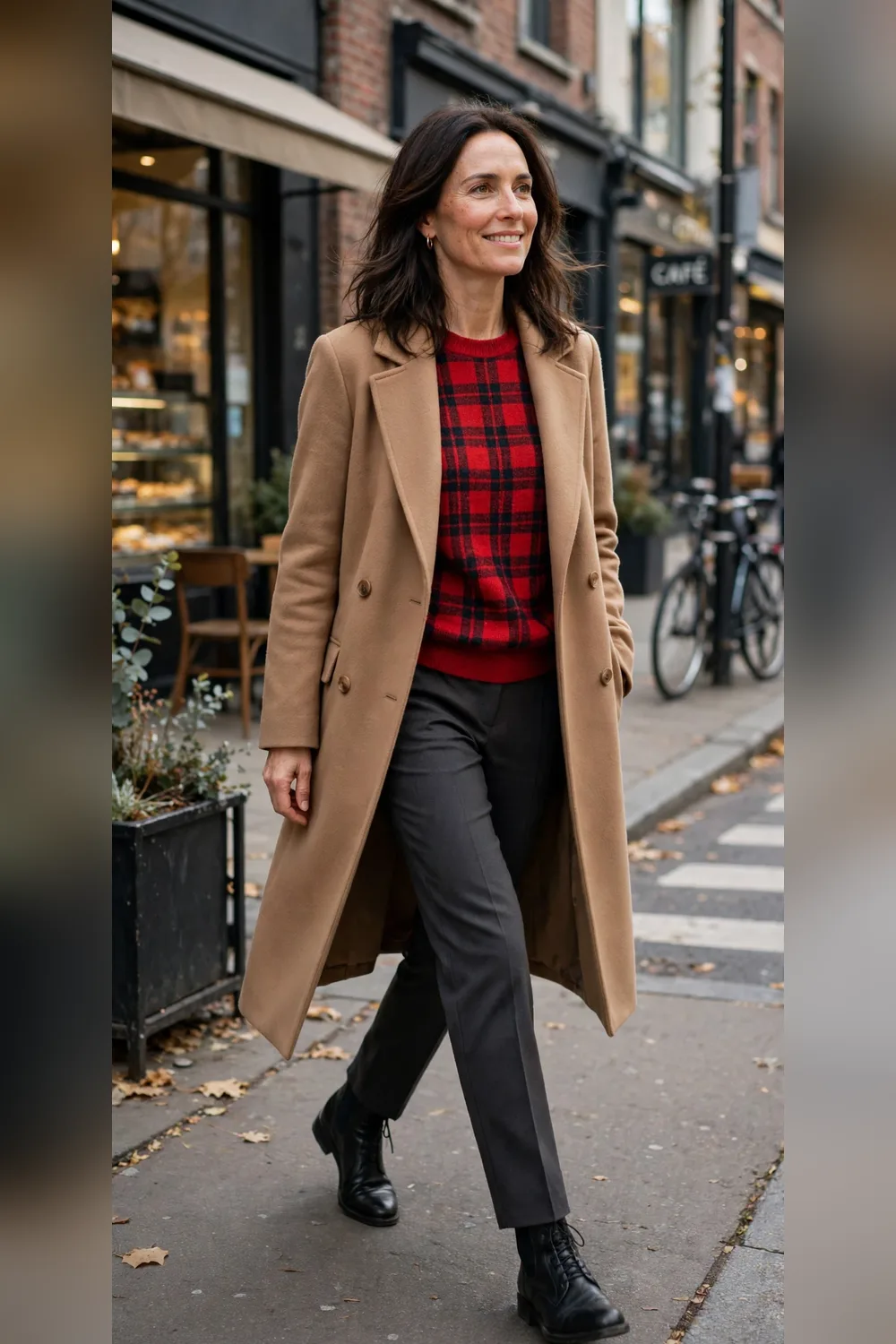
Keep the sweater as the only check, and let everything else be solid: solid coat, solid scarf, solid bag, solid shoes. This holds even when the second plaid is a different color — two checks never cancel each other out, they compete. The pairing I reach for most is a red plaid sweater with a solid camel coat, because the coat frames the check instead of fighting it.
The same discipline applies to other loud patterns. Stripes, animal print, and bold florals all fight plaid for attention, so save them for days when the sweater stays in the closet.

4. Layer It Right: Blazers, Coats, and Vests
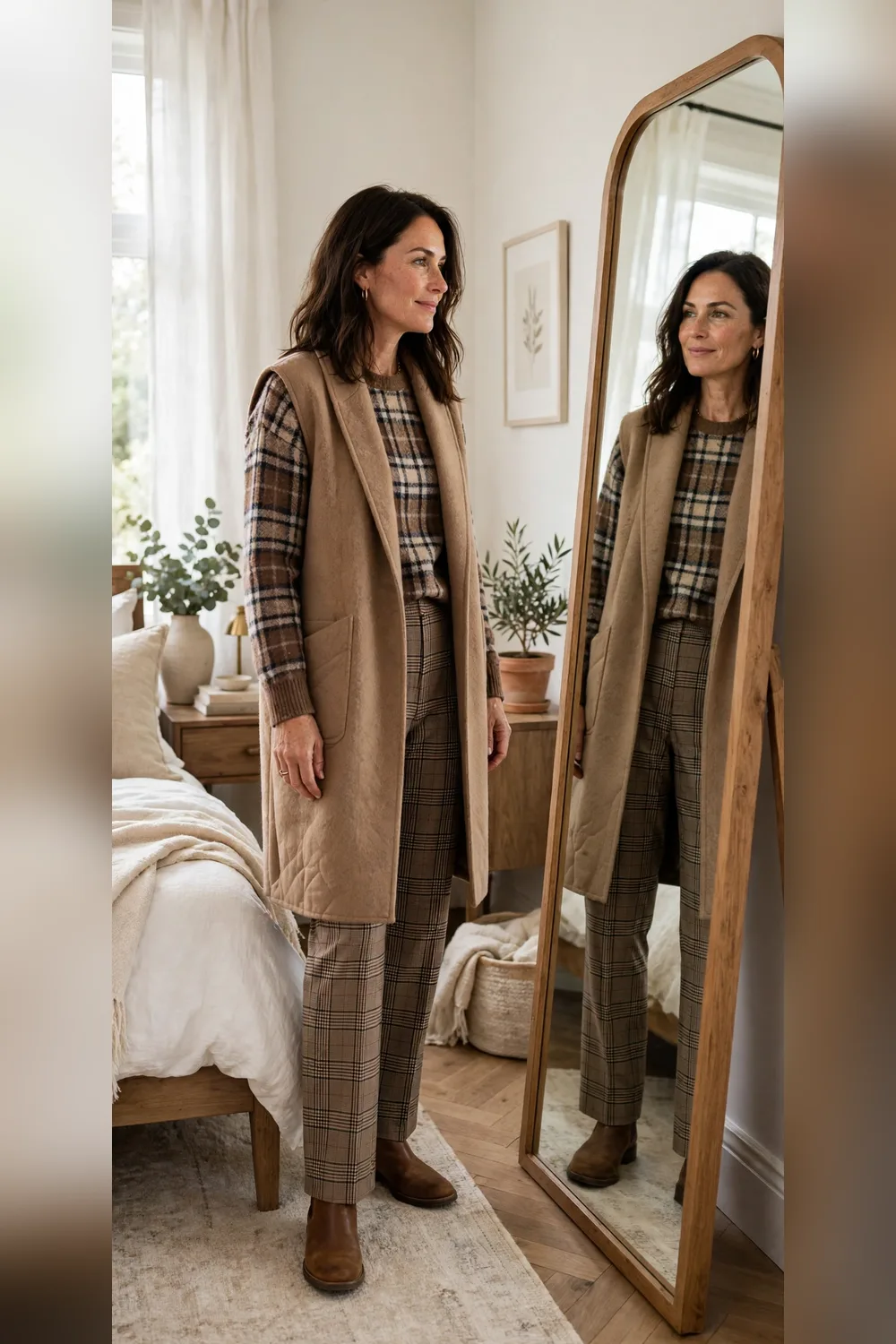
Layering order is where most plaid outfits go wrong. The rule is simple: the layer over the sweater should either show the check or frame it, never swallow it. A blazer worn open over a fine-knit plaid sweater works because the check stays visible down the front. A coat worn open over plaid works the same way. A closed, bulky coat over a chunky sweater hides the whole point of the outfit.
Vests are the easiest layer of all. A quilted puffer vest or a long wool vest worn open keeps your core warm while leaving the sweater’s sleeves and hem visible, and it comes off in one motion indoors. Blazers need a fine-knit sweater underneath — a chunky knit under a blazer strains at the buttons and bunches at the cuffs. Coats need length contrast: a hip-length sweater under a knee-length coat, or a cropped sweater under a longline vest, so each layer has its own line.
Try the layers on together before you commit. A blazer that will not close over the sweater, or a vest that pulls across the knit, will announce itself all day.

5. Fit and Tucking: Where the Sweater Should End
Fit decides whether plaid reads refined or sloppy. A fine-gauge sweater can be tucked, half-tucked, or left out, depending on the bottom half. A chunky sweater should never be tucked — the bulk at the waist undoes the outfit, and a half-tuck of a thick knit looks accidental rather than styled.
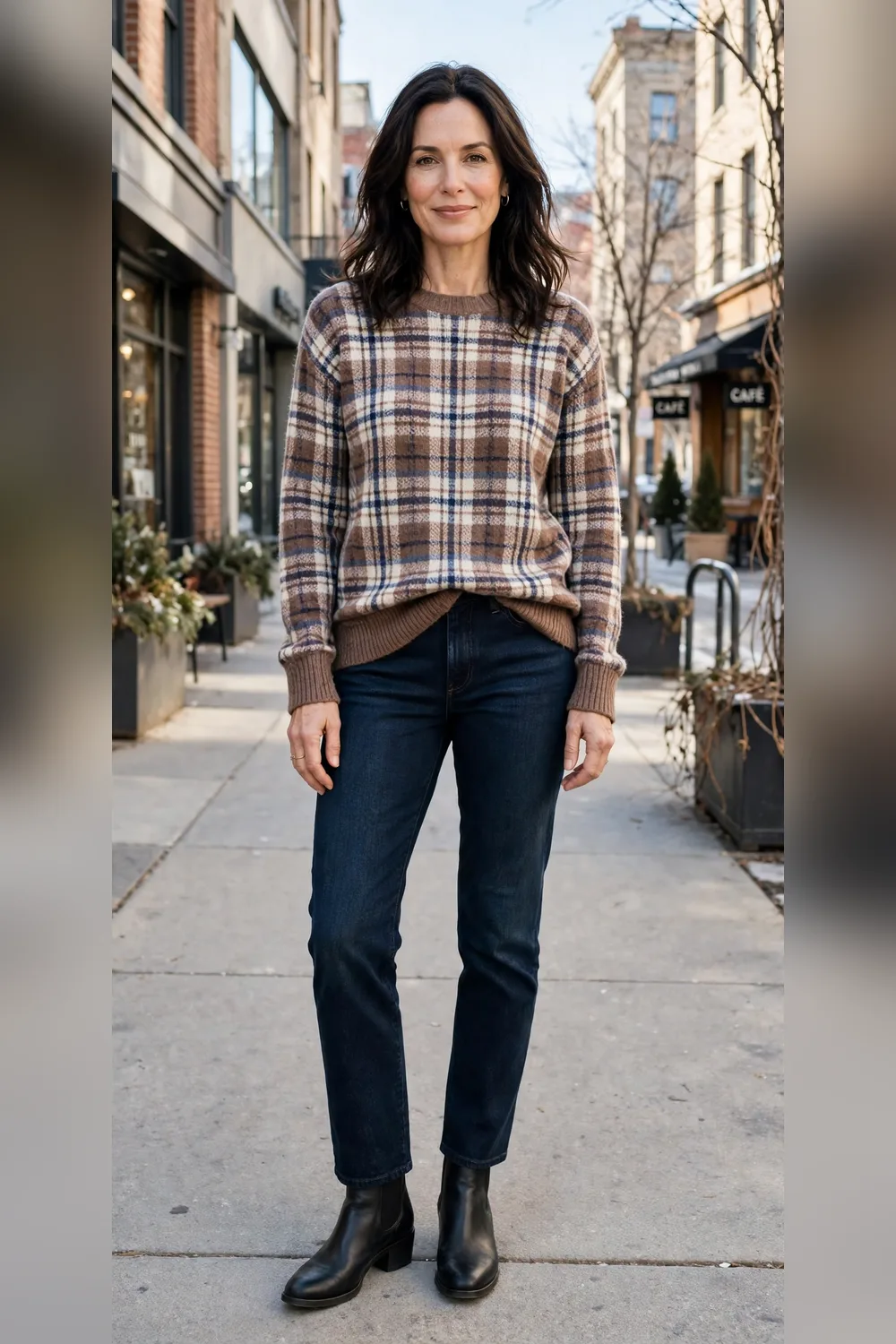
For a full tuck, choose a fine knit and trousers or a skirt with a waistband that sits flat at your natural waist. For a half-tuck, pull just the front center of the sweater into the waistband and let the sides fall — this works best with straight jeans and midi skirts, where the tuck marks the waist without hiding the sweater. Left untucked, the sweater hem should end at hip length over trousers, or just above the widest part of the hip over a skirt, so the proportions stay long.
The check itself gives you a fitting clue: if the horizontal lines of the plaid pull or bow across the bust or waist, the sweater is too tight. Plaid shows fit problems that solids hide, which is why trying it on — not just holding it up — matters.
6. Plaid With Jeans, Skirts, and Trousers
Jeans are plaid’s easiest partner, but the wash matters. Dark straight jeans keep red plaid grounded for work and evenings; light-wash jeans brighten it for brunch and daytime. Avoid faded, baggy jeans with a good sweater — the bottom half must be as intentional as the top, or the outfit slides into weekend mode no matter what the sweater cost.
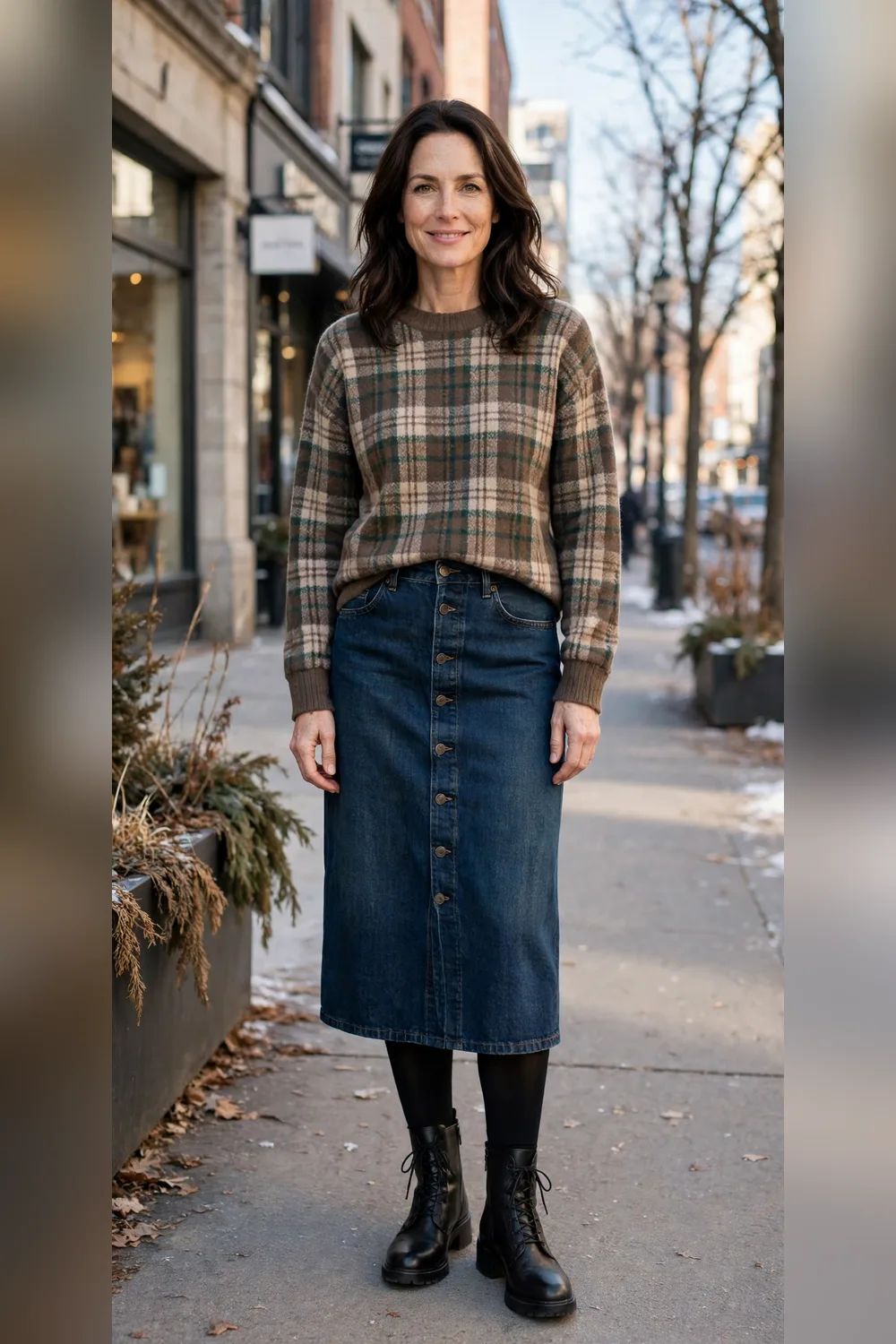
Skirts give plaid its dressier range. A dark denim midi skirt with tights and ankle boots makes plaid office-ready; a black satin slip skirt falling to mid-calf takes it to a party; a suede midi skirt with knee-high boots splits the difference. The hem rule is consistent: midi hems falling just below the knee or at mid-calf keep the outfit warm enough for winter and long enough for boots.
Trousers are the most refined option. Wide-leg trousers in black or cream balance a sweater’s volume, while straight tailored trousers in charcoal or navy make small-check plaid genuinely work-appropriate. With wide legs, the sweater should end right at the waistband with a front tuck to mark the line.
7. Plaid After Dark: Evening Looks
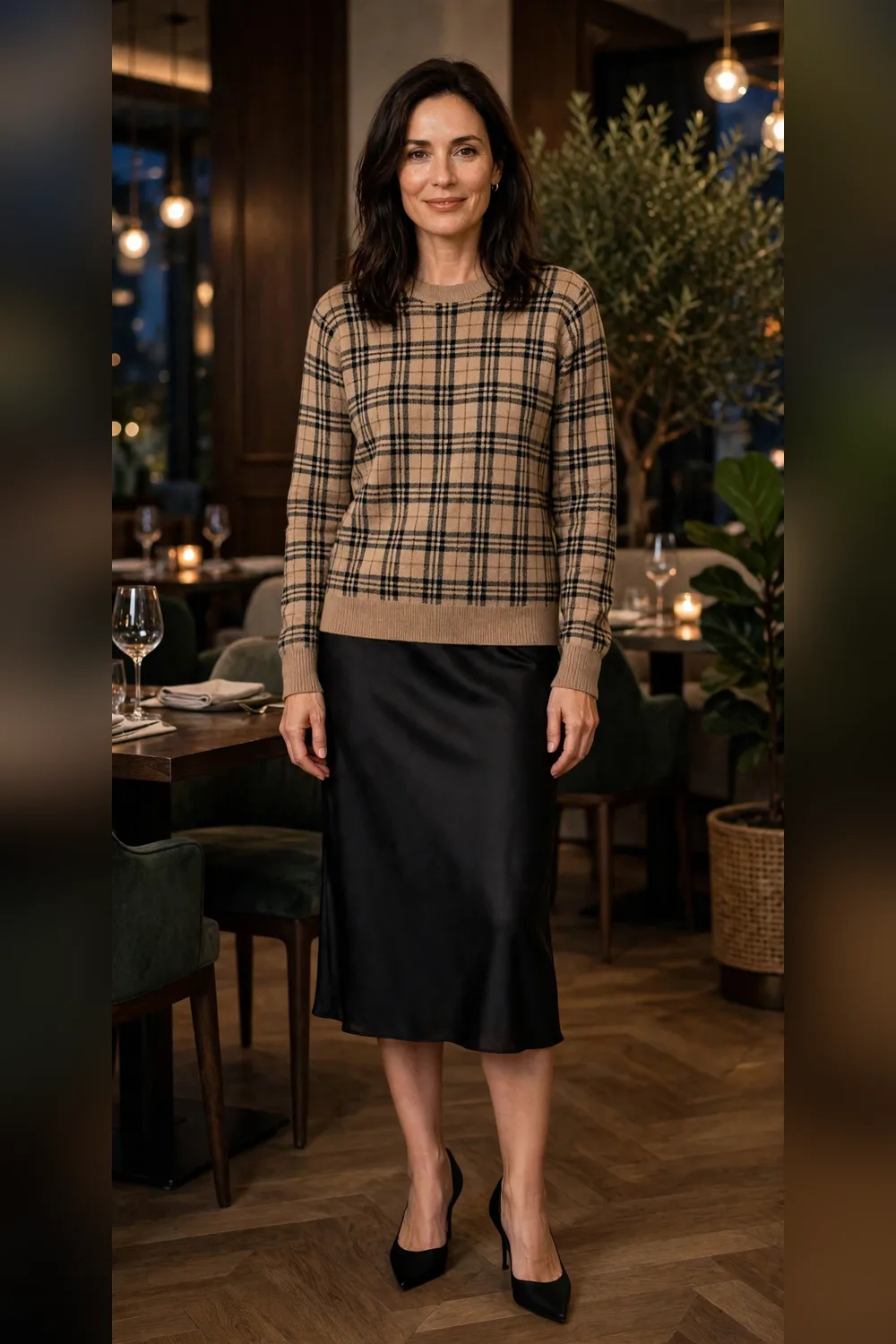
Plaid can go to a party — it just needs one dressy partner to lift it. The formula is a fine-gauge plaid sweater plus one piece with shine or drape: a satin slip skirt, a sequin midi skirt, velvet wide-leg trousers, or a pleated skirt in a dark metallic tone. The knit tones down the sparkle, the sparkle lifts the knit, and neither one wins.
Keep the rest of the evening outfit quiet. Pointed heels with a 2.5-inch heel keep the line long; one piece of jewelry — gold hoops or a fine chain — keeps the textures the focus. A black clutch and a red lip finish the outfit without adding another color story. The sweater itself should be fine-gauge and close-fitting for evening: a boxy sweater over sequins reads as something thrown on, not an outfit.
This is the same sweater you wore with jeans on Saturday, and nobody at the party will know. That range is exactly why plaid earns its closet space.
8. Common Mistakes to Spot Before You Leave the House
Run a five-second check in the mirror before you go. First, count the patterns: if there is more than one, remove one. Second, check the tuck: chunky knit tucked in, or a half-tuck pulling sideways, both need fixing. Third, look at the shoes — scuffed, faded, or the wrong weight for the outfit will drag everything down.
Fourth, check the scale match. A large buffalo check with tailored trousers and heels sends two messages at once; swap in a smaller check or swap the trousers for dark denim. Fifth, check the coat: if it swallows the sweater entirely when closed, wear it open or choose a vest instead. Five seconds, five fixes, and the outfit you already own looks like the outfit you meant to wear.
You might also love: the full outfit lists behind this guide — 25 Plaid Sweater Outfits for Women Over 40 and 20 Plaid Sweater Outfits for Women in Their 30s.
Mistakes to Avoid
- Wearing two plaids at once — a plaid sweater plus a plaid scarf or skirt turns a pattern into noise.
- Tucking a chunky sweater into trousers or a skirt — the bulk at the waist undoes the whole outfit; tuck only fine knits.
- Pairing a large check with tailored pieces — one of them must stay casual or the outfit loses its story.
- Letting faded, baggy jeans or scuffed shoes drag a good sweater down — the bottom half must be as intentional as the top.
FAQ
How do I wear a plaid sweater without looking too casual?
Keep one plaid piece per outfit and pair it with solid, refined partners — dark jeans, tailored trousers, or a wool skirt. A small-scale check in a fine knit reads as a pattern, not a costume, when everything around it is simple and well-fitted.
What colors go best with a red plaid sweater?
Black, charcoal, cream, camel, and dark denim all work, because they let the red lead. Avoid pairing red plaid with bright green or orange — those combinations fight the check instead of supporting it.
Can I wear a plaid sweater to work?
Yes, when the check is small-scale and the sweater is fine-knit. Layer it under a blazer with tailored trousers, or pair it with a structured skirt and tights, and it reads as office-appropriate rather than weekend wear.
What shoes work best with plaid sweater outfits?
Ankle boots with a 2-inch block heel cover most outfits, knee-high boots suit skirts and dresses, and clean loafers work for office looks. The rule is condition: clean, unscuffed shoes make the whole outfit look more considered.
How do I keep a plaid sweater outfit warm enough for deep winter?
Layer a thin thermal base under the sweater, add a long coat worn open over it, and wear opaque tights under any skirt. Knee-high boots close the last gap, and a solid scarf — never a second plaid — finishes the outfit.
Your Turn
You do not need a new wardrobe to wear plaid well — you need one good plaid sweater, dark bottoms you already own, and the discipline of one pattern per outfit. Start with the check scale, pick one dark neutral partner, and let the rest of these rules carry your plaid sweater outfits for women over 40 through winter.
📌 Save this guide on Pinterest before your next cold-weather closet edit — and when you want the outfits themselves, the plaid listicles in this series are waiting for you.
2 thoughts on “How to Style a Plaid Sweater: Checks, Colors, and Layers That Work for Women Over 40”